
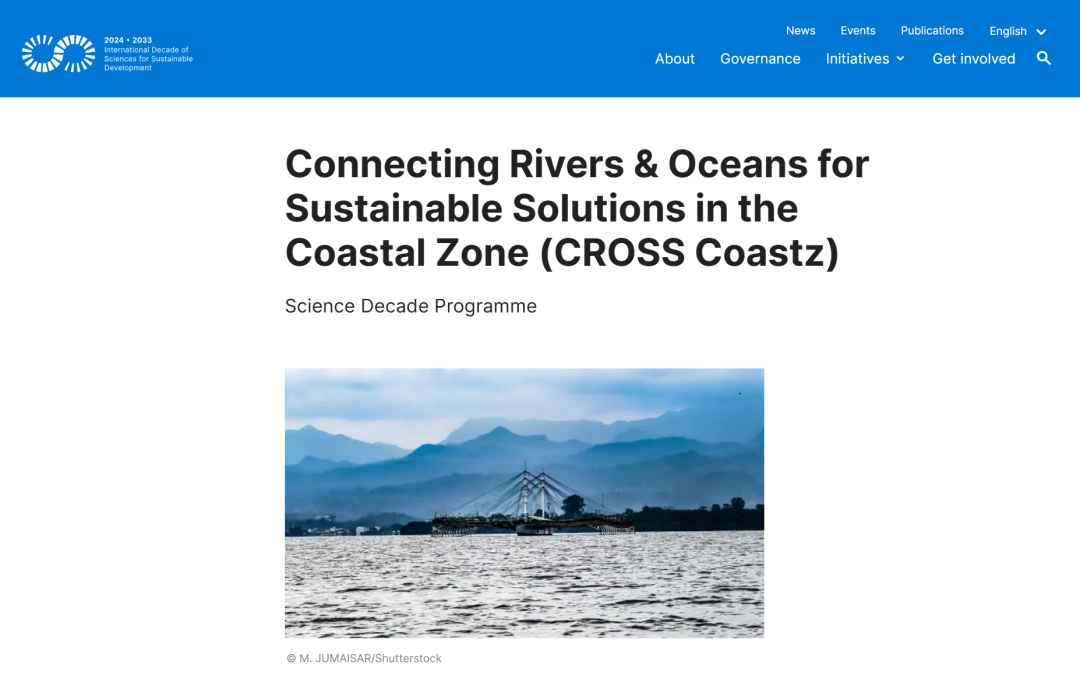
The programme “Connecting Rivers & Oceans for Sustainable Solutions in the Coastal Zone (CROSS Coastz)”, led by the State Key Laboratory of Estuarine and Coastal Research (SKLEC) at East China Normal University, has been officially selected as one of the first 25 endorsed Programmes under the United Nations International Decade of Sciences for Sustainable Development (2024–2033). This recognition marks another significant milestone in SKLEC’s international engagement, following the selection of its Mega-Delta Programme in 2021 as one of the first 28 endorsed Programmes under the UN’s Ocean Decade.
The resolution for the “International Decade of Sciences for Sustainable Development (2024–2033)” (referred to as the “Science Decade”) was adopted by the United Nations General Assembly in August 2023. Its objective is to harness the power of science, enhance global cooperation, and accelerate progress towards sustainable development. To implement this initiative, UNESCO launched a global call for proposals in October 2023. After a rigorous evaluation process, CROSS Coastz was endorsed as one of the Programmes in the initial endorsement cycle.
The endorsement of CROSS Coastz is a testament to China’s growing scientific leadership and global influence in promoting sustainability in coastal zones. It also underscores SKLEC’s leading role in advancing global coastal environmental governance and responding to climate change.
Focusing on Coastal Science Frontiers to Tackle Global Change
Coastal zones, where land meets sea, are among the most vulnerable regions to global environmental change. They are increasingly threatened by sea-level rise, extreme climate events, and human-induced impacts such as sediment imbalance, erosion, pollution, and ecosystem degradation. CROSS Coastz directly addresses these pressing global challenges, aiming to deepen scientific understanding of land-ocean interactions and to develop safe, sustainable pathways for environmental protection and societal resilience in coastal areas.
Driving Coastal Sustainability Through Interdisciplinary Collaboration
Integrating approaches from both the natural and social sciences, CROSS Coastz conducts systematic research on coastal geomorphological evolution, ecosystem functions, resource management, and socio-economic dynamics. The initiative targets major issues including coastal erosion, flooding, storm surges, water pollution, and ecological degradation. It promotes open science, stakeholder engagement, and cross-sectoral collaboration, with the goal of developing comprehensive solutions that unite climate adaptation, ecological restoration, and disaster prevention. These efforts aim to enhance the safety, well-being, and resilience of coastal communities while fostering inclusive and sustainable development.
Building a Global Research Network to Empower Scientific Decision-Making and International Cooperation
To launch CROSS Coastz, SKLEC built on its strong international scientific networks, including Future Earth Coasts (FEC) and Integrated Marine Biosphere Research (IMBeR), and collaborated with partners such as Delft University of Technology (Netherlands), Louisiana State University (USA), University of Chittagong (Bangladesh), University of Dar es Salaam (Tanzania), and University of São Paulo (Brazil). Looking ahead, CROSS Coastz will continue to expand its global collaboration network through platforms such as the UN Ocean Decade Mega-Delta Programme, Ministry of Education International Joint Laboratory for “Green Mega Deltas”, International Joint Laboratory of Estuarine and Coastal Research, Shanghai. The initiative will develop open-access data platforms, establish a multidisciplinary knowledge base for coastal systems, and strengthen global scientific understanding and forecasting capabilities. Through in-depth cooperation with global research institutions and expert teams, CROSS Coastz will provide solid scientific support for achieving the UN Sustainable Development Goals (SDGs). It represents both a contribution of Chinese expertise and a call for collective international action to build a safer, more resilient, and equitable future for coastal communities worldwide.
Relevant Links: